Quick answer:
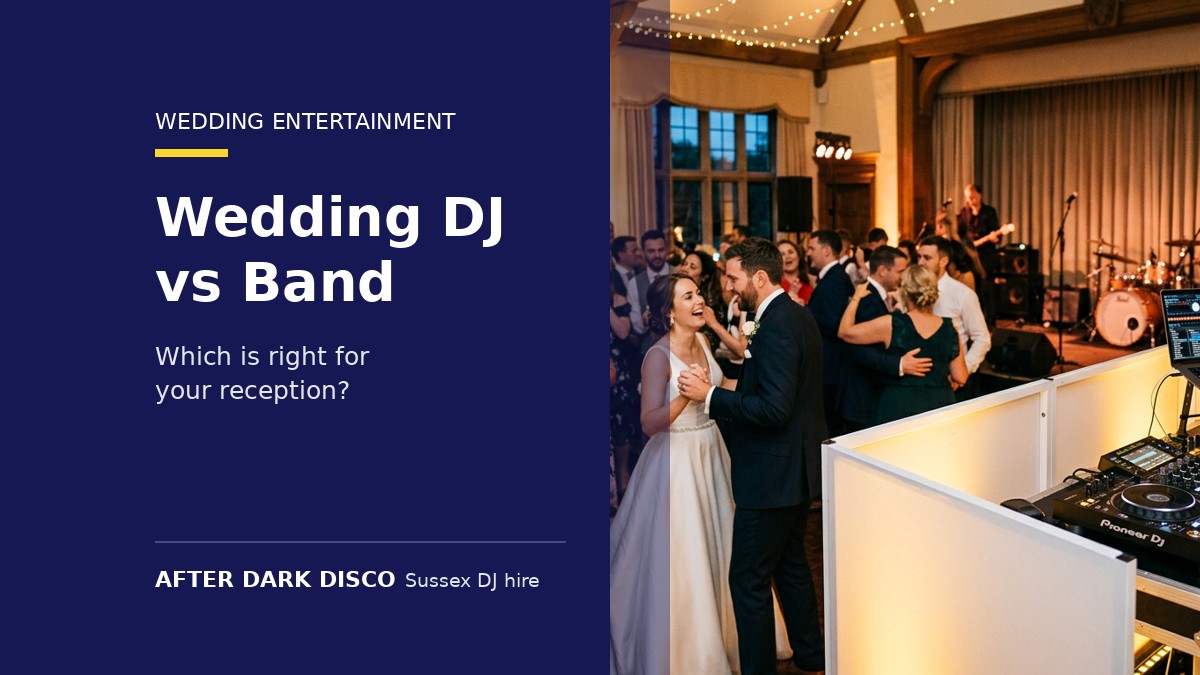
Choose a wedding DJ for wide music choice, flexibility, small spaces and strict volume limits. Choose a band for live performance and a stage focus when you have the space. Many couples combine both, with the DJ covering band breaks and the late night.
You have chosen the venue, the dress and the flowers. Now comes one of the biggest decisions of the day: what will keep your guests on the dance floor? The wedding DJ vs band debate lands on almost every couple’s list, and both options can be brilliant.
I am a DJ, so I will be upfront about my bias. I have also stood in the room while great bands play, and I have watched both choices work beautifully and fail badly. The difference is rarely about which one is better. It is about which one fits your wedding.
This guide compares the two honestly, using things that matter in real venues across Sussex, Surrey and Hampshire: music choice, space, atmosphere, timing and flexibility. By the end you should know which way to lean.
Wedding DJ vs Band: The Short Answer
A wedding DJ suits couples who want a wide range of music, a flexible running order and a setup that fits almost any venue. A live band suits couples who want a live performance, a strong visual focus and a particular kind of energy, and who have the space for it.
Neither is right for everyone. Many couples also combine the two, with a band for part of the night and a DJ to carry the rest. Let us look at each factor in turn.
1. Music Choice
DJ. A DJ can play the original recordings of thousands of songs, from a sixties soul classic to this week’s chart hit. You can request almost anything, change your mind a week before the wedding, and add a song on the night. If your guests range from teenagers to grandparents, that range is a huge advantage.
Band. A band plays its own set list, usually somewhere between 40 and 100 songs, performed live. A good band makes those songs sound fresh, and they bring real musicianship. But the repertoire is fixed, and adding a new song usually means rehearsal time.
If you have a very specific playlist, or an unusual genre in mind, a DJ gives you more control. My guide to wedding first dance songs and evening playlists shows how detailed that can be.
2. Space and Setup
DJ. A DJ system is compact. I can set up in a small function room, a village hall, a marquee corner or a barn. A typical setup takes up a table and a couple of speakers, and the lights are on stands. That is why my service fits so many different Sussex venues.
Band. Bands need a stage area, room for instruments, power for amplifiers and a sound check. A four piece band can take up a surprising amount of floor. If your venue is small or has a low ceiling, a band can feel cramped and loud.
If your venue has an unusual layout, ask whoever runs it how much space is available for entertainment. Then check it against the rider the band sends you.
3. Atmosphere and Visual Impact
DJ. A DJ’s atmosphere comes from sound and light. I bring computerised lighting, hazing and a clean, modern booth. For weddings I offer a Wedding White booth and a venue uplighting package, which gives the room a polished look. You can see how this works in my guide to uplighting and effects.
Band. A band gives your guests something to watch. A great frontperson can lead the room, bring the crowd forward and create unforgettable moments. If you love live music, nothing quite replaces that feeling.
Think about the energy of your own crowd. Some groups love watching a performance. Others prefer to dance with their friends and ignore the stage.
4. Time on the Dance Floor
DJ. A DJ can play continuously for hours. There are no breaks, no gaps and no waiting for the next set. The mix flows from one song to the next, which keeps momentum high.
Band. Bands normally play two or three sets with breaks between them. During breaks, a playlist or a DJ takes over. If that handover is smooth, the room barely notices. If it is not, the dance floor empties and takes a while to refill.
If you are choosing a band, ask what happens during the breaks and who is looking after the music. A DJ and a band working together can solve this neatly.
5. Flexibility on the Night
Weddings never run exactly to plan. Speeches overrun. The cake is late. A relative arrives from abroad and wants to hear a particular song.
DJ. A DJ adapts in seconds. I can bring a first dance forward, stretch a set, shorten a song or drop in a surprise request. I also make announcements and act as a master of ceremonies when you want one.
Band. A band can adapt too, but they have a set list and set timings. Changing the plan is usually more difficult.
For a closer look at timing, see my wedding timeline guide.
6. Volume and Venue Rules
Many Sussex venues have limits on volume. Some use sound limiters that cut the power if the level goes over a set threshold.
DJ. A DJ controls the output with precision. I set the level to suit the room and the venue’s rules, and I can keep the sound clear without pushing it too loud.
Band. Live drums and amplified instruments are harder to control. A band that is too loud can cause a limiter to trip and silence the whole room.
If your venue has strict rules, a DJ is usually the safer choice. And if the curfew arrives while your guests are still dancing, a silent disco can keep the party going after the speakers stop.
7. Variety of Entertainment
A DJ can offer more than music. Along with the disco, I can provide a close up table magician, a three channel silent disco, a wireless microphone for speeches and background music for the ceremony and wedding breakfast. My all day wedding services cover the whole day with one supplier and one point of contact.
A band tends to focus on the live evening performance. If you want other parts of the day covered, you will usually need extra suppliers.
8. Reliability and Backup
DJ. A professional DJ carries backup equipment. A good DJ also has insurance and tested equipment. My gear is fully insured and PAT tested, and you can see the paperwork on my PLI and PAT page.
Band. Bands rely on several people turning up on the same day. If one member is ill, the whole sound can change. Reputable bands usually have deputies, so ask about their policy.
Side by Side Comparison
| Factor | Wedding DJ | Live Band |
| Music range | Thousands of songs, any genre | Set list, usually 40 to 100 songs |
| Space needed | Small | Larger, needs a stage area |
| Setup time | Short | Longer, includes sound check |
| Continuous music | Yes | Breaks between sets |
| Flexibility | Very high | Moderate |
| Volume control | Precise | Harder to control |
| Visual focus | Lighting and booth | Performers on stage |
| Extras | Often includes MC, silent disco and more | Mostly live music only |
When a Wedding DJ Is the Better Choice
Choose a DJ if:
- You have a wide mix of ages and tastes among your guests.
- Your venue is small, has low ceilings or strict noise rules.
- You want to hand pick your own songs and keep flexibility.
- You want one supplier for the ceremony, breakfast and evening.
- You like the idea of a modern lighting show without a big stage.
When a Live Band Is the Better Choice
Choose a band if:
- Live performance matters more to you than variety.
- Your venue has plenty of space and a proper stage area.
- You want a focal point for the evening.
- You and your guests love one particular genre.
- Your venue has no tight volume limit.
Can You Have Both a DJ and a Band?
Yes, and plenty of couples do. A combined evening can look like this:
- A band plays two sets during the early evening.
- A DJ plays through the breaks, so the floor never empties.
- When the band finishes, the DJ takes over for the late night party.
This gives you the thrill of live music and the endless range of a DJ. The only catch is planning the handover, so both suppliers need to know the timings. If you choose this route, tell me which band you are booking and I will coordinate directly with them. You can find out what else to ask in my guide on the 5 questions to ask before hiring.
Questions to Ask Any Wedding DJ or Band
Whichever way you lean, ask these questions before you book.
- Have you played at my venue before, or at similar venues?
- What happens if you are ill on the day?
- Do you carry public liability insurance and PAT test your equipment?
- How do you handle requests and do not play lists?
- How long do you need to set up, and when do you need access?
- Can I meet you in person or on a video call before booking?
- What happens if the venue has a sound limiter?
My guide on how to hire a wedding or party DJ goes through these steps in more detail, and my post on the pecking order explains how the different suppliers at a wedding fit together.
Two Common Scenarios in Sussex
The compact venue. Imagine a manor house room with a low ceiling and a strict noise limit. A band would struggle for space and volume. A DJ fits the room, keeps the level under the limiter and still delivers a full dance floor.
The big barn. Now imagine a large barn and a crowd that loves rock. A band can shine here, and a DJ can fill the gaps between sets and carry on to midnight.
Both set ups work because they match the venue and the guests.
You can see examples of my own weddings on my videos page and read more about one of them in my blog on a wedding at Bignor Park.
How to Decide in Three Steps
If you are still torn, try this.
Step 1: Picture your guests. Imagine your friends and relatives at 9pm. Are they watching a stage, or are they dancing in a crowd to songs they know? Your gut answer is usually right.
Step 2: Check your venue. Ask about space, power, volume limits and finishing time. This often decides the question for you.
Step 3: Talk to the supplier. Meet or call at least one DJ and one band. The way they listen, answer and plan tells you a lot about how they will behave on the day.
What Your Guests Will Remember
Years after a wedding, guests rarely recall the exact songs. They remember how the night felt. Was the dance floor full? Did the music suit everyone? Did the evening flow without awkward gaps?
A DJ tends to deliver consistency. The music stays in step with the room, the transitions stay smooth and the night builds steadily. A band tends to deliver peaks. A great live moment can lift the whole room, but the gaps between sets can bring the energy down.
Neither approach is wrong. Ask yourself what kind of memory you want: a long, steady night of dancing, or a series of big live moments.
Where Wedding Entertainment Fits in the Day
Entertainment starts well before the evening. Your ceremony needs music, your drinks reception needs a relaxed backdrop and your wedding breakfast needs something gentle in the background. A band rarely covers all of these, and a DJ often does.
If you book a full day service, one supplier can take care of arrival music, ceremony music, background music and the evening party. That keeps communication simple and reduces the number of people you need to coordinate on the day. My all day wedding DJ services page explains how an early set up, ceremony music and evening entertainment fit together.
Planning Tips for Either Choice
Whichever option you pick, these habits will keep the planning smooth.
- Visit the venue with your supplier in mind. Look at the space, the power points and the layout.
- Share your timeline early. The earlier your supplier sees the plan, the better they can prepare.
- Agree on a finishing time. Check what your venue allows, and tell your supplier exactly when the music must stop.
- Write a short brief. List your must play songs, your do not play songs and any special moments such as a first dance or a cake cutting.
- Appoint a point of contact. Choose a friend or family member who can answer questions on the day, so you do not have to.
Frequently Asked Questions
Is a DJ or a band better for a wedding?
Neither is better in every case. A DJ offers wide music choice, flexibility and an easy setup. A band offers live performance and a strong visual focus. The best choice depends on your venue, your guests and your music taste.
Can a wedding DJ play live music?
A DJ plays recorded music, though some DJs add a live instrument or singer. I focus on recorded tracks and can coordinate with a live act that you book separately.
Do bands need a DJ at a wedding?
Not always, but bands take breaks. A DJ or a playlist usually fills the gaps. Many couples hire a DJ to play between sets and after the band finishes.
Which is better for a small wedding venue?
A DJ is usually the better fit for a small room. Bands need space for instruments and speakers, and volume can be difficult to control in a small space.
How long does a wedding DJ play for?
Most wedding DJs play for around four to five hours in the evening. If you book a full day service, the DJ also covers ceremony music and background music during the wedding breakfast.
Can I choose the songs a wedding DJ plays?
Yes. You can send a playlist, a must play list and a do not play list. A good DJ will blend your choices with their reading of the room.
Final Thoughts From the DJ Booth
The wedding DJ vs band question comes down to your venue, your guests and the kind of night you want. If you value range, flexibility and a smooth, continuous dance floor, a DJ is a safe and brilliant choice. If you crave a live performance and have the space for it, a band can be unforgettable. And if you cannot decide, combine them.
If you are planning a wedding in Sussex, Surrey or Hampshire and want a DJ who skips the cheese unless you ask for it, I would love to hear about it. Call me on 01903 741025 or 07816 344543, or send your details through my contact page and I will reply within 24 hours.
Celebrating with younger guests too? My kids disco party ideas guide covers family events.